HomeY.1564 Certification
ITU-T Y.1564 certification with every installation

Quality demonstrated, not promised

Quality demonstrated, not promised. Every Olivet Telecom connection ships with a signed ITU-T Y.1564 certification report, 5 auditable KPIs and simultaneous multi-stream testing. It's not a speed test — it's the international standard for validating Ethernet services in production with contractual PASS/FAIL thresholds.

Three reasons to demand certification

Why "the speedtest shows fine" is not enough.

Auditable evidence

A signed report with date, time, measurement equipment and results. Tomorrow, in an ISO audit, a claim or an operator switch, the proof is in your hand.

Enforceable SLA

The 5 Y.1564 KPIs match the ones in your contract. You have measured, verifiable figures for each penalty criterion.

A baseline to compare with

If an app feels slow tomorrow, you have an initial reference. The NOC can repeat the test and detect real degradation versus the day of installation.

What is measured, exactly

Five parameters, each with a contractual threshold and PASS/FAIL outcome.

CIRCommitted Info RateGuaranteed bandwidth
EIRExcess Info RatePermitted burst
FTDFrame Transfer DelayOne-way latency
FDVFrame Delay VariationJitter
FLRFrame Loss RatioPacket loss

One methodology, two clear phases

What we actually do on your line before handing over the service.

A · The standard

ITU-T Y.1564 — built for production networks

Y.1564 is an ITU-T recommendation published in 2011 that replaces RFC 2544 for commercial Ethernet services. The IETF itself confirms this in RFC 6815: RFC 2544 was meant for lab use and should not be applied to production networks. Y.1564 was born precisely to fill that gap.
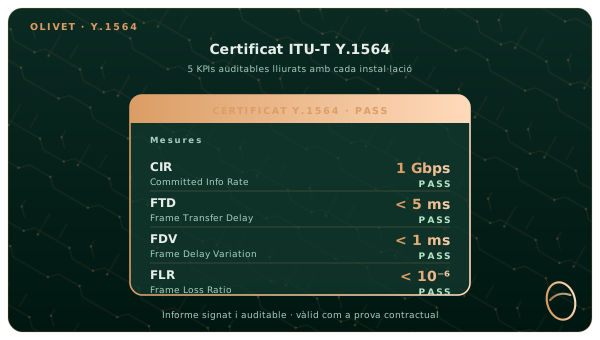
  • International recommendation adopted by operators worldwide
  • PASS/FAIL thresholds tied to the contractual SLA
  • Deterministic durations that can be replicated
  • Simultaneous multi-stream: reflects real usage
Diagram: Y.1564 test overview with the five main KPIs
B · The 5 KPIs

What is measured and why each one matters

Quality isn't just "plenty of Mbps". It's a combination of five parameters that, together, define the real user experience. Y.1564 validates them simultaneously, not separately, because the combined behaviour is where degradation actually shows up.
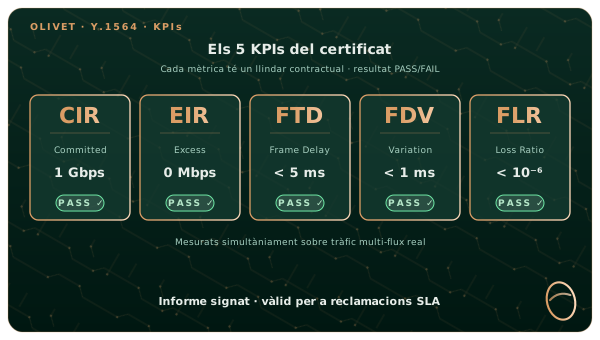
  • CIR 1 Gbps symmetric · bandwidth contractually guaranteed
  • EIR additional burst without degrading the CIR
  • FTD < 5 ms · one-way latency, critical for video calls and VoIP
  • FDV < 1 ms · jitter, critical for audio and video streaming
  • FLR < 10⁻⁶ · loss, critical for TCP and sensitive SaaS
Diagram: the 5 Y.1564 KPIs (CIR, EIR, FTD, FDV, FLR) with typical thresholds
C · Two phases

Service Configuration Test + Service Performance Test

A Y.1564 test is split in two phases with different goals. The first verifies that the service can reach the CIR without losing packets via a progressive ramp-up. The second sustains traffic for an extended period to validate the stability of all 5 KPIs under continuous load.
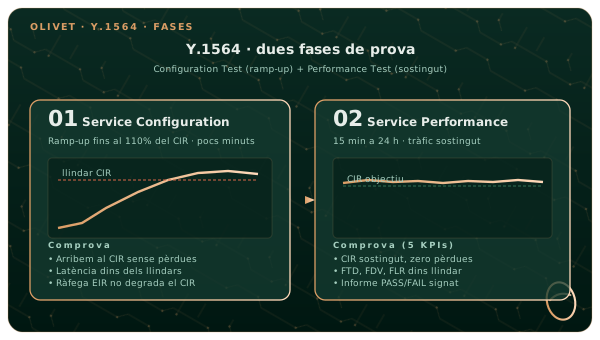
  • Phase 1 (Configuration): ramp-up to 110% of CIR · a few minutes
  • Phase 2 (Performance): sustained traffic for 15 min to 24 h
  • Final report with PASS/FAIL per KPI
  • Digital signature from the measurement device for auditability
Diagram: the two Y.1564 phases with ramp-up and sustained test
D · Simultaneous multi-stream

Because testing a single stream misses the point

The key difference with RFC 2544 is simultaneous multi-stream. Y.1564 generates several traffic classes at once (voice, video, data) and measures the KPIs for each one. This mirrors real office usage and catches SLA violations that a single-stream test would never see.
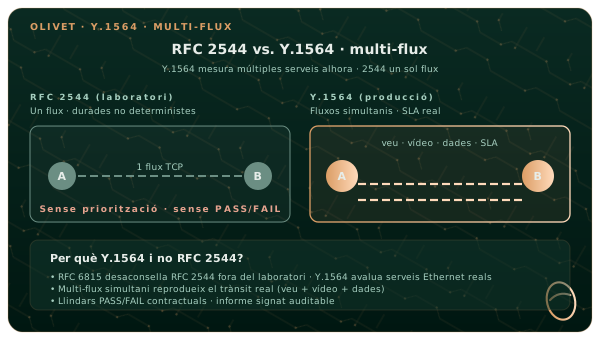
  • More than one service measured simultaneously
  • Variable packet sizes (64B to 1518B)
  • Differentiated classes with Ethernet priority close to ORO
  • Realistic validation of the network under production load
Diagram: comparison between single-stream RFC 2544 and multi-stream Y.1564 testing

Speedtest · RFC 2544 · Y.1564

What each kind of measurement actually delivers — and why certification makes the difference.

CharacteristicTypical speedtestRFC 2544Y.1564 (Olivet)
PurposeIndicativeLab✓ Production
Simultaneous streams11✓ Multiple
KPIs measured1 (speed)3-4✓ 5 (all)
PASS/FAIL thresholdsNoNot defined✓ Contractual
Deterministic durationVariableNo✓ Yes
Signed reportNoNo✓ Yes
Valid for SLA claimsNoNo✓ Yes

Technical questions

What systems teams usually ask us about Y.1564.

What exactly is ITU-T Y.1564?
An ITU-T recommendation for validating Ethernet services in production. It defines a two-phase methodology that simultaneously measures bandwidth, latency, jitter and loss against PASS/FAIL thresholds.
Why is RFC 2544 unsuitable for production networks?
It was meant for lab use. The IETF itself warns in RFC 6815: 2544 uses a single stream, non-deterministic durations, and has no PASS/FAIL thresholds. Y.1564 was created to fill that gap.
Which five KPIs does it measure?
CIR, EIR, FTD (latency), FDV (jitter) and FLR (loss). Every metric has a contractual threshold and a PASS/FAIL outcome.
How long does the test take and is it intrusive?
Configuration takes a few minutes; Performance runs 15 minutes (default) or up to 24 hours on request. It is carried out during installation and does not affect customer production.
Does the certificate serve as legal evidence?
Yes. The report is auditable, signed and traceable to the measurement equipment. Accepted by ISO audits, quality certifications and SLA claims.
Can the test be repeated later?
Yes. The Olivet NOC can schedule a new Y.1564 test on request, in the same format for easy comparison.

Want your Y.1564 report?

Every Olivet Telecom connection ships with ORO active and a signed ITU-T Y.1564 certificate. No extra cost, no lock-in.