HomeHigh-Availability Router
Carrier-class inside your rack

Zero single points of failure. Zero.

Zero single points of failure. Every installation ships with a Raisecom RAX711-C-R-AC/DC — a carrier-grade NID router with dual hot-swap power supplies, four 10GE uplinks and sub-50 ms protection protocols. The same kind of equipment backbone operators use at the network edge.

Three benefits of a carrier-class router

A home router is not a business router. Here's what changes.

Two of everything, always

Two hot-swap power supplies, dual fibre uplinks, dual paths into Olivet's network. If one fails, the other carries the full traffic without anyone noticing.

Millisecond failover

BFD, VRRP, ERPS (G.8032) and MC-LAG. If a link breaks or a gateway fails, switchover takes under 50 ms — imperceptible for VoIP, video calls or SaaS.

Monitored from the NOC

Continuous telemetry (voltage, temperature, SFP DDM, CPU, memory) into Olivet's 24/7 NOC. We see problems before you notice them — and often before they happen.

Four figures that define the RAX711-C-R

It's not just any CPE. It's a 10G operator-grade NID.

99.999%Uptime target
<50 msFailover (BFD, ERPS)
52 Gbps × 2Switching fabric
4 × 10GESFP+ uplink

Four layers of redundancy

Availability is built. It's not promised.

A · Hardware

RAX711-C-R ports, fabric and dimensions

A half-19-inch form factor (220 × 266 × 44 mm · 2.5 kg · ≤ 40 W). Front panel: 4 × 10 Gbps SFP+ uplinks, 12 × 1 Gbps SFP user ports, one RJ-45 management port and one USB console. 52 Gbps × 2 switching fabric and a 32k MAC address table. Operating temperature of −20 °C to +65 °C, ideal for tech rooms without dedicated cooling.
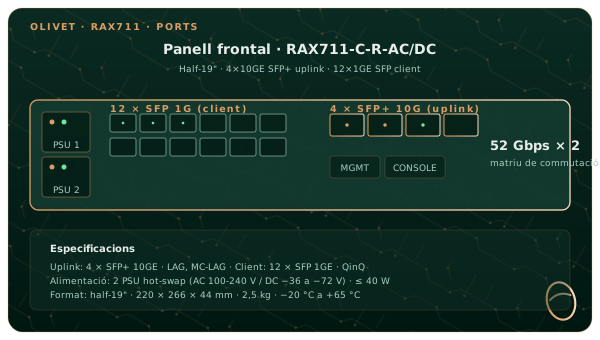
  • 4 × SFP+ 10G · uplink to Olivet's network
  • 12 × SFP 1G · flexible customer ports
  • Jumbo frames up to 12,288 bytes
  • IPv4 and IPv6 dual stack, static and dynamic (OSPF, BGP4)
Diagram: RAX711 front panel with 4×10G SFP+, 12×1G SFP and dual PSU
B · Physical redundancy

Dual power, dual fibre, dual path

The AC/DC variant accepts an AC (220 V) feed and a DC (−48 V) feed simultaneously — or two AC, or two DC. Both are hot-swappable: they can be replaced live without stopping the router. We connect them to independent electrical circuits backed by separate UPS banks.

The dual 10GE uplink exits through two physically separate fibres toward two Telefónica access points. Egress uses LAG or MC-LAG so both paths are active at the same time — not a passive backup, but active-active with double the bandwidth when everything is up.
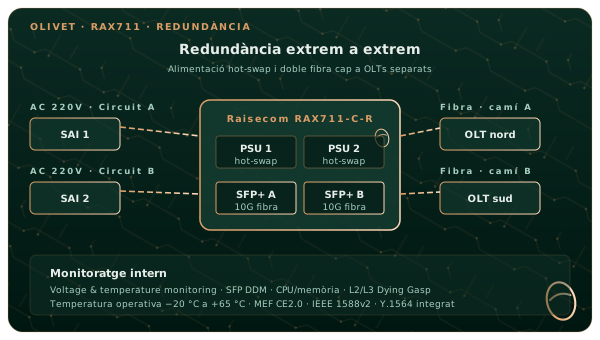
  • 2 × hot-swap PSU · AC 100-240 V or DC −36 to −72 V
  • Internal monitoring of voltage and temperature
  • L2/L3 Dying Gasp on power loss
  • Compliance CE, UL, FCC · RoHS · MEF CE2.0
Diagram: dual power and dual fibre uplink into separate OLTs
C · Protection protocols

Detect and react in milliseconds

A redundant router is only useful if it reacts fast when things break. The RAX711 ships with the same protection protocols operator networks rely on:
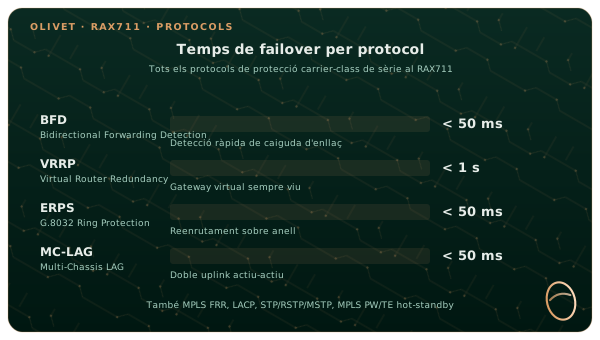
  • BFD (Bidirectional Forwarding Detection): link failure detection in < 50 ms for static and dynamic routes
  • VRRP: virtual gateway with shared IP · the customer LAN never loses its gateway
  • ERPS G.8032: Ethernet ring protection · < 50 ms switchover on a broken segment
  • MC-LAG: dual uplink aggregation across two chassis · zero loss on failover
  • MPLS FRR (TE/LDP/VPN) for inter-DC routes
Diagram: switchover time per protocol (BFD, VRRP, ERPS, MC-LAG)
D · OAM and certification

Measurable by the NOC, enforceable in the contract

Protection is worthless if it can't be verified. The RAX711 embeds hardware-based OAM per IEEE 802.1ag and ITU-T Y.1731 (CCM at 3.3 ms minimum interval) for fast fault detection, and Y.1564 SAT integrated to run the same certification delivered with your installation report.
  • Y.1731 performance monitoring at microsecond resolution
  • Y.1564 SAT for Ethernet, IP and MPLS L2VPN/L3VPN
  • TWAMP-Lite for active latency monitoring
  • SyncE and IEEE 1588v2 TC · network synchronisation
  • SNMPv3, SSHv2, ZTP · secure NOC management
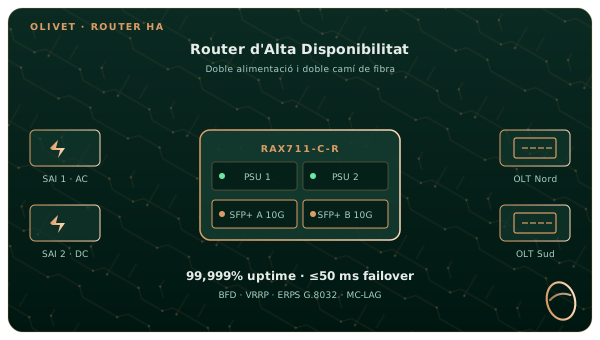
Diagram: Olivet HA router with power and link redundancy

Datasheet at a glance

What stays on your rack panel.

ModelRaisecom RAX711-C-R-AC/DCCompact 10G NID · half-19"
Uplinks4 × 10GE SFP+LAG, MC-LAG, LACP
Customer ports12 × 1GE SFPPVLAN, super VLAN, QinQ
Capacity52 Gbps × 2Switching fabric
Power2 × hot-swapAC 100-240 V · DC −36 to −72 V · ≤ 40 W
Dimensions220 × 266 × 44 mm · 2.5 kgHalf-19" 1U
Op. temperature−20 °C to +65 °CHumidity 10-90% non-condensing
ComplianceCE · UL · FCC · RoHSMEF CE2.0 · IEEE 1588v2 · Y.1564

Home router vs. Olivet CPE

Why the RAX711 isn't the router you have at home.

CharacteristicTypical home routerOlivet · RAX711-C-R
Power1 external brick✓ 2 hot-swap PSU (AC + DC)
Uplink1 Ethernet WAN✓ 4 × 10GE SFP+ with MC-LAG
FailoverManual reboot✓ BFD/VRRP/ERPS < 50 ms
OAM / monitoringBasic stats✓ Y.1731 hardware · Y.1564 SAT
SynchronisationNTP✓ SyncE · IEEE 1588v2
Op. temperature0-40 °C office✓ −20 °C to +65 °C
ManagementLocal web UI✓ 24/7 NOC · SNMPv3 · SSHv2
MTBF / SLANot specified✓ Carrier class · 99.999%

Technical questions

What systems teams usually ask us about the HA router.

Why do we use the Raisecom RAX711-C-R?
It's a carrier-class NID, not a home router. Dual hot-swap PSU, operating temperature −20 °C to +65 °C, 52 Gbps × 2 fabric and OAM/protection on par with backbone networks.
What does 'uptime target 99.999%' mean?
The industry's 'five nines': at most ≈ 5 min 16 s of outage per year. It's achieved by combining local redundancy (PSU, fibre, sub-50 ms protocols) with network redundancy (dual Cloud Router at BA1 and Templus).
Can I bring my own router?
We deliver the RAX as a service demarcation so we can guarantee the contracted SLA (Y.1564, hardware OAM, BFD). You can plug your firewall/router behind it on a customer port and manage it yourself.
How is firmware updated?
The NOC manages firmware centrally with advance notice, except for critical security updates. The RAX supports ZTP and, thanks to dual PSUs and network redundancy, updates are non-disruptive.
Does it work with DC −48 V power?
Yes. The AC/DC variant accepts an AC feed and a DC feed at the same time (or two of either). Ideal for tech rooms with standard telco DC batteries.
Does it support network synchronisation?
Yes: SyncE and IEEE 1588v2 (PTP TC). Useful for sectors with strict synchronisation needs (finance, broadcast, SCADA) or mobile backhaul over the same connection.

Want an operator-grade router at your office?

Every Olivet Telecom connection ships with the RAX711-C-R-AC/DC with all protection protocols enabled and 24/7 NOC monitoring. No activation fee, no lock-in.