HomeORO Priority
Premium quality profile over the NEBA network

Your traffic, always at the front

Your business traffic always moves at the front of the queue. On shared fibre, not every bit travels equally. With the ORO profile (p-bit 3, IEEE 802.1p) your whole office has contractually guaranteed precedence over residential Best Effort. This is not marketing: it's a technical QoS mechanism implemented end-to-end over Telefónica's NEBA access network.

Three tangible benefits of ORO priority

What it means for your office, every day and especially during peak hours.

Speed under load

When the access network approaches saturation (evenings, local incidents, seasonal peaks), your ORO Gbps holds pace while the neighbouring Best Effort loses speed.

Enforceable SLA

ORO isn't a marketing stamp: it's a contractual clause with measurable parameters (CIR, FTD, FLR). If it's not met, financial compensation kicks in.

No oversubscription

Residential operators share capacity 10:1 or 50:1. ORO is born with reserved bandwidth; Olivet also caps the base at 1,000 customers to give the network dimensional safety.

Four numbers that define the ORO profile

Not marketing: technical parameters printed on the service sheet.

p-bit 3IEEE 802.1p mark
QinQDouble tag 802.1ad
1 GbpsDedicated CIR
1 : 1Maximum subscription

Four layers, one service level

From the fibre cable to your router, every segment preserves the ORO priority.

A · NEBA network and ORO

A service profile defined by regulation

NEBA (Nuevo Servicio Ethernet de Banda Ancha) is the regulated wholesale product through which alternative operators access Telefónica's fibre network. On top of NEBA, quality profiles are defined: Best Effort for residential, and ORO for premium business services.
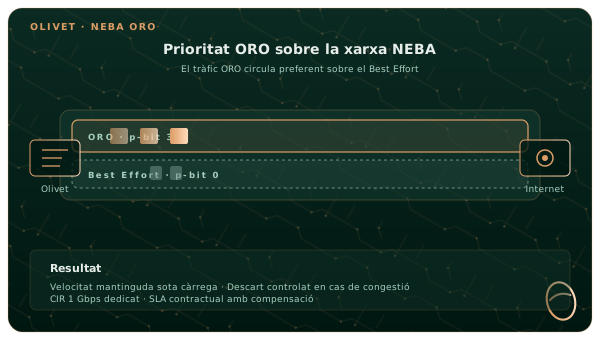
  • Defined at the CNMC: public, auditable parameters
  • Logical separation from residential traffic
  • Dedicated bandwidth for each ORO customer
  • Applied end-to-end, not just on the last mile
Diagram: ORO traffic path with precedence over Best Effort in the NEBA network
B · IEEE 802.1p QoS

Eight priority levels · you get the third highest

The IEEE 802.1p standard defines 8 traffic classes (p-bit 0 to 7) that switches and routers use to decide packet output order. P-bit 0 is Best Effort (residential), 7 is network control. Your business traffic is tagged with p-bit 3, reserved to the ORO profile.
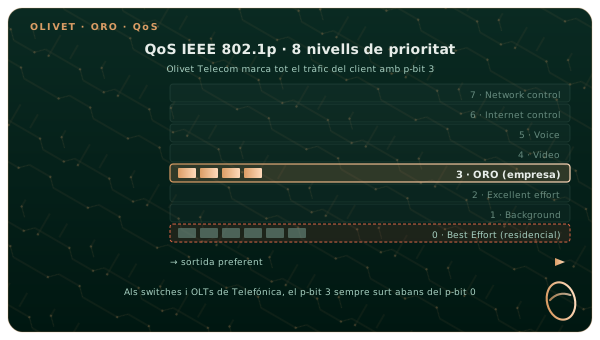
  • Preferential queue at Telefónica's switches and OLTs
  • Controlled drop under congestion: Best Effort goes first
  • Stable latency regardless of neighbouring traffic
  • Verifiable with capture tools (Wireshark, tcpdump)
Diagram: 8 IEEE 802.1p priority levels with p-bit 3 highlighted for ORO
C · QinQ encapsulation (802.1ad)

Two VLAN tags, one clean frontier

For priority to travel across Telefónica's core without mixing with other operators' traffic, QinQ double tagging (IEEE 802.1ad) is used: an outer tag (S-TAG) identifies the wholesale service carrying ORO priority, an inner tag (C-TAG) identifies Olivet's service within it.
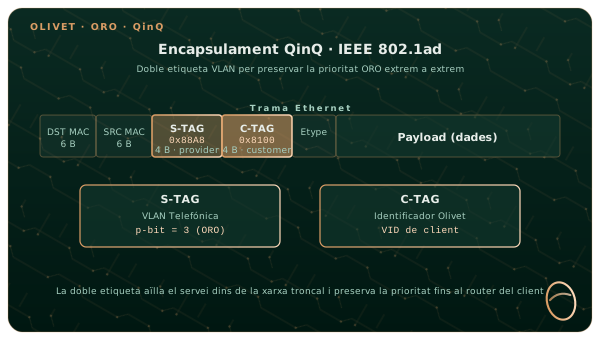
  • S-TAG (0x88A8): ORO priority on the Telefónica network
  • C-TAG (0x8100): service identifier inside Olivet
  • Zero interference with VLANs from other operators
  • Clean delivery of an Ethernet port at your office
Diagram: Ethernet frame with QinQ S-TAG and C-TAG double tagging
D · Dedicated CIR and subscriber cap

A reserved Gbps, no small print

Tagging priority is worthless if aggregated capacity isn't dimensioned. That's why ORO comes with a CIR (Committed Information Rate) of 1 Gbps reserved per customer, and Olivet Telecom caps the base at 1,000 customers to ensure the network never operates outside contracted parameters.
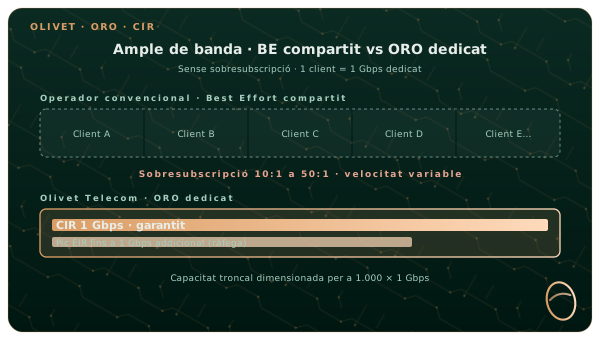
  • CIR 1 Gbps symmetric, contractually guaranteed
  • EIR available for bursts without degrading CIR
  • No oversubscription: 1 customer = 1 dedicated Gbps
  • Backbone capacity dimensioned for 1,000 × 1 Gbps
Diagram: bandwidth allocation comparison between shared Best Effort and dedicated ORO

Best Effort vs. ORO

What changes when your traffic travels with the ORO profile instead of Best Effort.

CharacteristicBest Effort (residential)ORO (Olivet Telecom)
QoS markp-bit 0✓ p-bit 3
Queue preferenceLast✓ Preferential
Behaviour under congestionFirst to drop✓ Protected
BandwidthShared 10-50:1✓ Dedicated 1 Gbps CIR
EncapsulationSingle VLAN✓ QinQ 802.1ad
Contractual SLA"Up to" best-effort✓ Measurable and auditable
Quality certificationNot included✓ ITU-T Y.1564

Technical questions

What systems teams usually ask us about ORO.

What does 'ORO priority' actually mean?
ORO is one of the QoS profiles defined on Telefónica's NEBA network. It marks every Ethernet frame with p-bit 3 (IEEE 802.1p), telling network equipment that this traffic has precedence over residential Best Effort.
Is it the same as 'Premium' residential fibre?
No. Residential 'Premium' offers typically use PLATA or BRONZE profiles with lower precedence. ORO is the highest profile available and is reserved for regulated business services.
Is the difference noticeable day to day?
Especially under load: when an access node approaches saturation, ORO traffic holds its speed while Best Effort slows down. For video calls, VoIP and critical SaaS the gain is direct.
Can I see p-bit tags from my office?
Yes, with professional tools like Wireshark on a port mirror. The QinQ tags are visible between Olivet's router and Telefónica's OLT. At the customer's premises it arrives as a clean Ethernet port.
Does this relate to net neutrality?
Net neutrality concerns treatment between applications within a customer. ORO acts between customer profiles, not between applications: all your business traffic travels at the same priority.
What if the CIR is not delivered?
Unlikely because Olivet caps subscribers to 1,000 and NEBA capacity is dimensioned with margin. If it happened, the contract includes an SLA with financial compensation and the Y.1564 certificate serves as auditable proof.

Want your connection with ORO priority?

Every Olivet fibre ships with ORO active by default and an auditable Y.1564 certificate. No lock-in, no small print.