Fewer support tickets
Many "Internet is slow" complaints aren't about bandwidth: they're about sporadic losses misread by TCP. FlowEngine absorbs them before they become a ticket.

We get peak performance out of every bit of your connection. The Internet is not perfect: remote servers, intermediate congestion and even your own WiFi introduce imperfections that standard TCP misreads. Olivet FlowEngine is the proprietary engine we built to extract real value from every Mbps of your fibre.
We don't talk about technology for its own sake. This shows up every day at the office.
Many "Internet is slow" complaints aren't about bandwidth: they're about sporadic losses misread by TCP. FlowEngine absorbs them before they become a ticket.
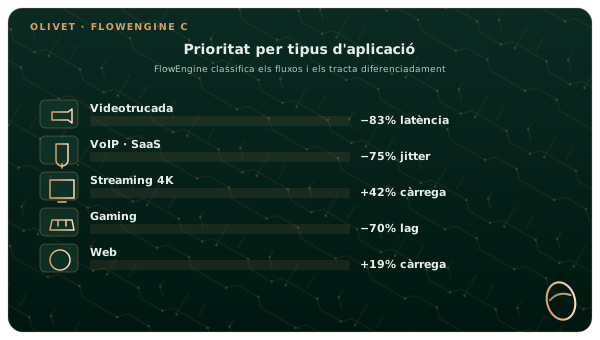
Interactive applications (Teams, Meet, VoIP, cloud ERP) get automatic priority. Under load, your office keeps flowing.
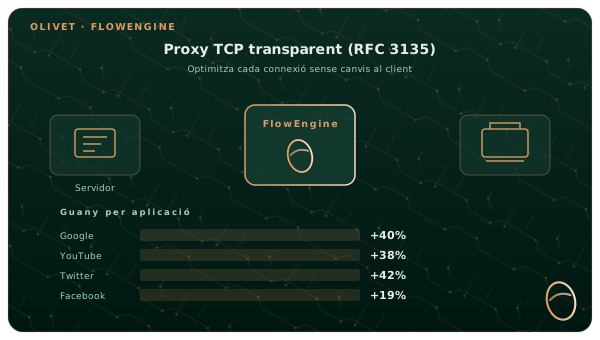
Without changing a single cable in your office, FlowEngine speeds up page loads by 19-42% and removes the bufferbloat that made your 1 Gbps feel slower.
Data can be reproduced with any public tool: speedtest, waveform.com/tools/bufferbloat, WebPageTest.
Each FlowEngine module solves a specific real-network problem.
FlowEngine runs inside Olivet Telecom's infrastructure, between your office and the wider Internet. Per RFC 3135, it terminates and re-opens each TCP session applying our optimisations without changing anything on the client: no agent, no configuration, no compromise on end-to-end encryption (TLS).
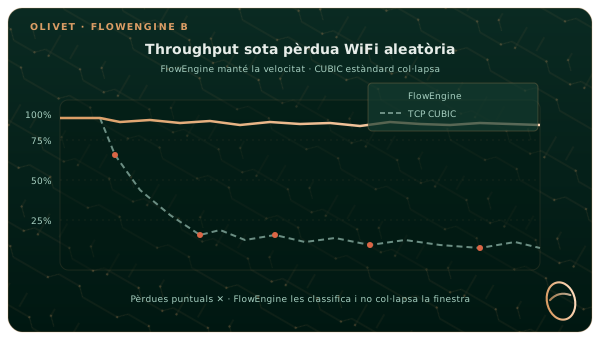
Standard TCP (CUBIC) reacts the same way to any packet loss: aggressively slowing down. The problem? In your office, most losses come from WiFi (interference, noise), not from real congestion. Collapsing speed is the wrong response.
FlowEngine analyses transmission-rate trends in short windows and distinguishes between the two cases. When loss is accidental, it holds throughput. When it's real congestion, it backs off with precision.
Not all traffic is equal. A video call or a VoIP session tolerates very little latency but little bandwidth; a backup or a Docker pull tolerates latency but demands all the bandwidth it can get. FlowEngine recognises these patterns and treats them differently.
It does so without inspecting content: packet size, cadence, RTT and window sizes are analysed to classify each flow. Patterns are kept up to date from our NOC.
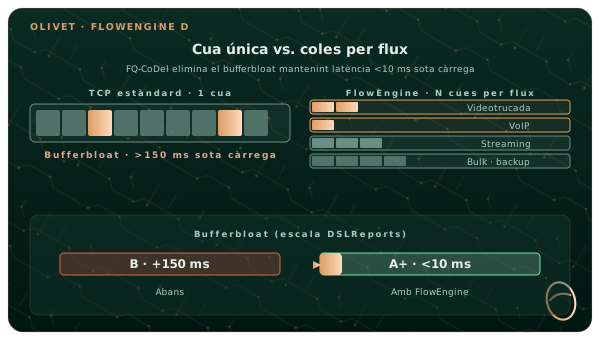
Bufferbloat is the hidden cause of "slow Internet under load": critical packets wait behind huge buffers full of bulk traffic. FlowEngine implements enhanced FQ-CoDel with one queue per flow and L4S support (Low Latency, Low Loss, Scalable throughput), keeping latency under load below 10 ms.
Details matter when your whole office depends on it.
| Behaviour | Standard TCP (CUBIC) | Olivet FlowEngine |
|---|---|---|
| Loss detection | Always slows down | ✓ Loss vs. congestion aware |
| Response to WiFi jitter | Throughput collapse | ✓ Holds speed |
| Per-application priority | None — all traffic equal | ✓ Five automatic classes |
| Bufferbloat | Single queue, latency >150 ms | ✓ FQ-CoDel + L4S, <10 ms |
| ECN / L4S support | Limited / disabled | ✓ On by default |
| Client configuration | Not applicable | ✓ None — 100% transparent |
| Gain certification | Self-reported | ✓ Y.1564 auditable |
What systems teams usually ask us.
Every Olivet Telecom connection ships with FlowEngine enabled by default and an auditable Y.1564 report. No lock-in, no small print.