Real geographic redundancy
Barcelona and L'Hospitalet are separate municipalities interconnected at backbone level. Taking both down at once needs an extraordinary-scale incident — and even then the RTO target is < 2 seconds.

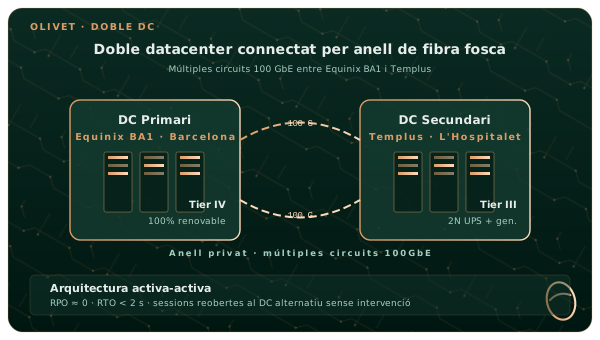
Our Cloud Router runs simultaneously in two Catalan datacenters — Equinix in Barcelona and Templus in L'Hospitalet de Llobregat — interconnected by a private dark-fibre ring with multiple 100 GbE circuits. DDoS protection, firewall, IPS/IDS and DNS filtering included, always active on both sides.
Not a corporate postcard. A real architecture.
Barcelona and L'Hospitalet are separate municipalities interconnected at backbone level. Taking both down at once needs an extraordinary-scale incident — and even then the RTO target is < 2 seconds.
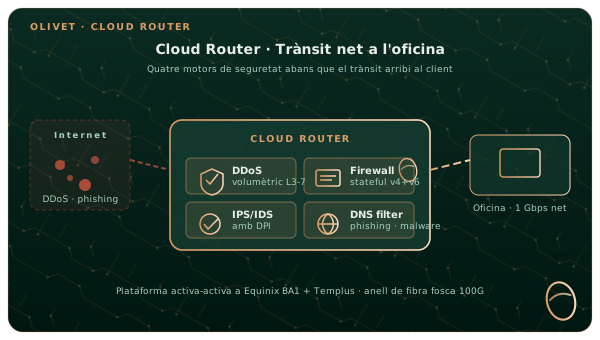
The Cloud Router filters DDoS, applies firewall, runs IPS/IDS and blocks malicious domains before traffic reaches your office. Your contracted Gbps is useful Gbps.
The two DCs are a few km apart, in the same metropolitan area. Replication between them is sub-millisecond; no Internet route hops through the US to filter your traffic.
From your office to Olivet's private cloud, with no blind spots.
The Cloud Router is a platform managed by Olivet Telecom that processes all customer traffic before it reaches the office. Designed so you don't need to buy or maintain any security appliance on your rack.
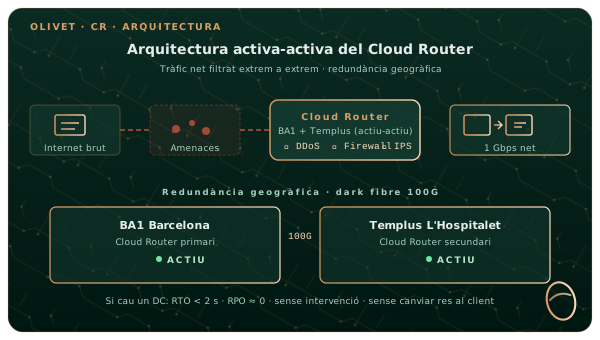
The platform lives in two physically separated datacenters inside the Barcelona metropolitan area. This isn't backup redundancy: both DCs are live at the same time and share traffic in real time. If one goes down, the other absorbs the full load without dropping sessions or losing packets.
We don't trust public networks for DC interconnect. Between Equinix and Templus we run our own dark-fibre ring: two optical paths physically apart that loop around Barcelona, so a single roadworks or a cable cut cannot take both out at once.
On top of that ring we run multiple 100 GbE circuits in LAG with ERPS G.8032 protection. Latency between the two DCs is sub-millisecond, enabling synchronous replication of the Cloud Router control plane and a practical RPO ≈ 0.
An active-active setup is more robust than a primary-secondary pair: both DCs already carry real traffic every second. There's no "wait for the test" to know whether the backup works — if one stops responding, the Cloud Router's BGP and routing protocols drop the affected sessions and reopen them on the other DC.
Uptime target 99.999% — at most ≈ 5 min 16 s of accumulated downtime per year.
What a redundant in-Catalonia platform changes.
| Characteristic | Traditional operator | Olivet · dual DC |
|---|---|---|
| Points of presence | 1 DC or generic cloud | ✓ 2 DCs in Catalonia |
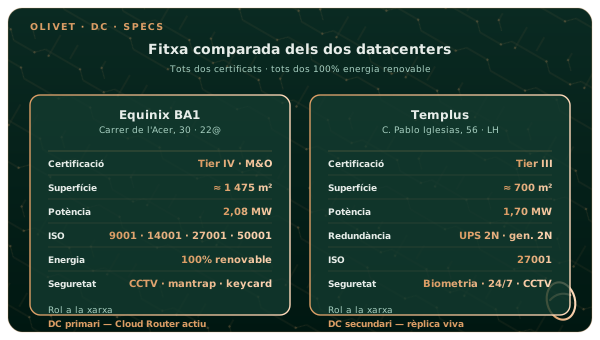
| Certification | Variable | ✓ Tier III · 2 DCs |
| Interconnect | Public Internet | ✓ Private dark fibre |
| Inter-DC capacity | Best effort | ✓ Multiple dedicated 100 GbE |
| Operating mode | Active-passive | ✓ Active-active |
| RPO | Minutes | ✓ ≈ 0 |
| RTO | Minutes / hours | ✓ < 2 s |
| Data location | Often outside the EU | ✓ Always in Catalonia |
| Energy | Generic mix | ✓ 100% renewable |
Every Olivet Telecom connection ships with the Cloud Router active on both DCs, at no extra cost and with no per-endpoint licensing. No lock-in, no small print.